
 TWITTER

Superman III
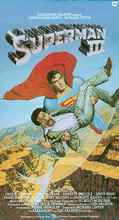
Synopsis of Movie
“I ask you to kill Superman, and you can't do that one simple thing.”
After taking on Lex Luthor and three Kryptonian supervillains, Superman battled his greatest foe yet: comedian Richard Pryor. All right, so he ain’t exactly Bizarro or Mr. Mxyzptlk, but Richard (Gus Gorman in the film) did have the mighty power of the computer in his corner.
Gus Gorman is introduced as a perpetual loser who discovers an inborn talent for computer programming. Hired by corporate megalomaniac Ross Webster, Gus is dispatched to Smallville (Superman’s hometown) to reprogram a weather satellite to destroy Colombia’s coffee crop. Meanwhile, Clark himself has decided to return to Smallville, trying to get back to his roots. With his on-again, off-again girlfriend Lois Lane back in the big city, Clark rekindles a romance with high school sweetheart Lana Lang.
All is small-town happiness and tranquility until Clark discovers Gus’ fiddling and puts a stop to it as Superman. That puts him on Webster’s bad list, and the arch-villain commands Gus to develop a synthetic substitute for Kryptonite. With his computer prowess, Gus is able to identify most of the components, but a few read as “Unknown.” Fearing the price of failure, Gus improvises, listing cigarette tar as the missing ingredient.
The tar-laced Red Kryptonite splits our hero literally in two, with one half good and one half darkly evil. The two sides battle each other for supremacy. Meanwhile, Gus has developed a supercomputer for Webster. Once Superman defeats his dark self (sorry for ruining the suspense), Webster turns the computer’s awesome capabilities against the Man of Steel, leading to a chase between our hero and a nuclear missile in the Grand Canyon (while an Atari-produced video game parallels the action).
Much of the original cast returned for this third installment, with Margot Kidder making a brief appearance as Lois. Apparently, comedy didn’t score as well with audiences as the more straightforward heroics of the first two films, but Superman III was still successful enough to inspire a fourth installment in 1987. And to put collectors’ minds at rest (and whip the ultra-collectors into a frenzy), the video game seen in the film was in development at Atari but never saw the light of day.
Movie Release History
1978 - Superman1980 - Superman II
1983 - Superman III
1987 - Superman IV: The Quest for Peace
Movie Sub Categories
live-actionsci-fi/fantasy
action/adventure
comedy
Movie Studio
Warner Bros.Cast
Superman Christopher ReeveClark Kent Christopher Reeve
Gus Gorman Richard Pryor
Perry White Jackie Cooper
Jimmy Olsen Marc McClure
Lana Lang Annette O'Toole
Vera Webster Annie Ross
Lorelie Ambrosia Pamela Stephenson
Ross Webster Robert Vaughn
Lois Lane Margot Kidder
Brad Gavan O'Herlihy
Unemployment Clerk Nancy Roberts
Blind Man Graham Stark
Penguin Man Henry Woolf
Man in Cap Gordon Rawlings
Bank Robber Peter Wear