
 TWITTER

Tarzan (series)
Synopsis of Movie
“ At first, I thought he was a savage, but I found out he wasn't, that's all.”
Edgar Rice Burrough's bare-chested, loinclothed lord Tarzan has ruled the pop culture landscape since his first All-Story Magazine appearance back in 1912. Since then, the man-born/ape-raised hero has starred in literally hundreds of stories, movies, comic strips, radio and TV shows, including more than 75 feature films. Brave, strong and just a little bit wild, Tarzan was an ideal hero for the silver screen, and Hollywood recognized it almost immediately.
Tarzan’s first feature adventure came not long after the hero debuted on the printed page. Tarzan of the Apes, a 1918 silent, starred Elmo Lincoln as the screen’s first Tarzan, an orphaned English baby raised by apes in the wilds of Africa. After growing to manhood, Tarzan becomes King of Apes, ruling with the might of his father’s hunting knife and defending his adopted kin from villagers and other threats. Scientist’s daughter Jane Porter makes her first on-screen appearance in this film as well, learning to love the wild ape man and teaching him how to love in return.
A handful of other Tarzan features followed, starring Lincoln and others. With the transition from silent to sound pictures, Tarzan got his first chance to air his now-famous yell, courtesy of Frank Merrill in 1929’s serialized Tarzan the Tiger. The screen’s most famous Tarzan, however, was yet to come.
1932’s Tarzan the Ape Man marked the debut of former Olympic swimmer Johnny Weissmuller as the well-chiseled Tarzan. Setting aside the origin story, this film focuses on an expedition to find the legendary elephant burial grounds, site of untold wealth in ivory. James Parker leads the expedition, and his daughter Jane insists on joining him. Parker’s young assistant Harry Holt has his eye on the lovely Jane, but she prefers a more exotic lifestyle. When Tarzan and his band of apes (including a chimp named Cheetah) kidnap the English lass, she gets her wish.
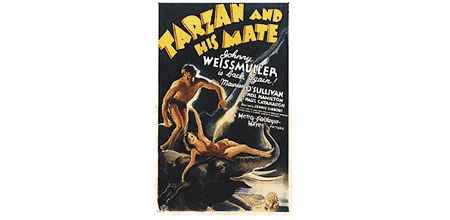
Joining the athletic Weissmuller was the equally attractive Maureen O’Sullivan as a surprisingly spunky Jane. The two made a dynamic screen pair, and audiences clamored for more. MGM delivered, teaming up Weissmuller and O’Sullivan for five more films: Tarzan and His Mate (1934), Tarzan Escapes (1936), Tarzan Finds a Son (1939), Tarzan’s Secret Treasure (1941) and Tarzan in New York (1942), the last of which served as an inspiration for a later wildman, Crocodile Dundee.
The Tarzan franchise moved from MGM to RKO in 1943, and Weissmuller swung along for the ride (O’Sullivan opted out). 1943’s Tarzan Triumphs brought in Frances Gifford as the ape man’s new female companion, a jungle princess named Zandra who comes to Tarzan for aid when Nazi paratroopers invade her city. Nazis in a Tarzan movie may have seemed like an odd fit, but this was merely the start of Weissmuller’s unusual co-stars.
Tarzan’s Desert Mystery (1943) brought more Nazis, along with scheming Arabs and giant prehistoric creatures. This was followed by Tarzan and the Amazons (1945), Tarzan and the Leopard Woman (1946), Tarzan and the Huntress (1947) and finally Tarzan and the Mermaids (1947), each matching the King of Apes with a bevy of exotic females.
Weissmuller left the series after Tarzan and the Mermaids, but RKO and producer Sol Lesser decided to keep the franchise alive. Lex Barker was brought in as the new star, playing Tarzan in five features, from Tarzan’s Magic Fountain (an eternal youth story) in 1949 to Tarzan and the She-Devil (another dangerous, yet alluring female) in 1953. Significantly, the third of the Lex Barker Tarzan films, Tarzan’s Peril, was the first to actually be shot on location in Africa.
Even with more accurate locations, the Tarzan series had slipped from the lofty heights of its Weissmuller/O’Sullivan heyday. Still, the kids liked jungle pictures, and an inexpensive Tarzan movie was usually a safe bet. Gordon Scott donned the loincloth for six Tarzan films, starting with Tarzan’s Hidden Jungle (1955) and winding up with Tarzan the Magnificent in 1960.
With backing from Paramount, the last two of these films tried to move beyond the kiddie matinee reputation the series had earned, having Tarzan chase down diamond hunters (including then-unknown Sean Connery) in Tarzan’s Greatest Adventure (1959) and escorting a prisoner through the dangerous jungle in 1960’s Tarzan the Magnificent. Tarzan was given a larger vocabulary than “Unagawa!” and “Me Tarzan, you Jane,” and his adventures were more elaborate to match.
The Tarzan movies continued through the 1960’s, as men like former stuntman Jock Mahoney (the villain in Tarzan the Magnificent), Mike Henry and TV Tarzan (and future Doc Savage) Ron Ely took on the role. After Ely’s Tarzan and the Four O’Clock Army, the ape man disappeared from the big screen for over a decade, reappearing in the more adult-oriented Tarzan, the Ape Man (1981), which retold the legend from Jane’s point of view. With sex symbol Bo Derek as Jane, the film was decidedly not for the same audience as earlier ventures.
Greystoke: The Legend of Tarzan, Lord of the Apes (1984) gave future Highlander star Christopher Lambert the leading role, once more re-inventing the Edgar Rice Burroughs tale. This time out, the King of Apes is brought back to “civilization” when a Belgian ship captain discovers Tarzan may actually be the heir to the Earl of Greystoke.
The final live-action Tarzan to date arrived in 1998. Billed as “a new Tarzan for a new generation,” Tarzan and the Lost City cast Casper Van Dien in the title role, battling mercenaries after running away from civilization. The film was little seen in theaters, as most kids preferred to wait for the following year’s Tarzan animated feature from Disney. The most successful Tarzan film to date, Disney’s version introduced an entire new audience of youngsters to the exotic hero, holding out the promise that Tarzan’s jungle adventures will continue for years to come.
Movie Release History
1918 - Tarzan of the Apes1918 - The Romance of Tarzan
1921 - The Adventures of Tarzan
1927 - Tarzan and the Golden Lion
1929 - Tarzan the Tiger
1932 - Tarzan the Ape Man
1934 - Tarzan and His Mate
1936 - Tarzan Escapes
1939 - Tarzan Finds a Son
1941 - Tarzan's Secret Treasure
1942 - Tarzan in New York
1943 - Tarzan Triumphs
1943 - Tarzan's Desert Mystery
1945 - Tarzan and the Amazons
1946 - Tarzan and the Leopard Woman
1947 - Tarzan and the Huntress
1947 - Tarzan and the Mermaids
1949 - Tarzan's Magic Fountain
1950 - Tarzan and the Slave Girl
1951 - Tarzan's Peril
1952 - Tarzan's Savage Fury
1953 - Tarzan and the She-Devil
1955 - Tarzan's Hidden Jungle
1957 - Tarzan and the Lost Safari
1958 - Tarzan's Fight for Life
1958 - Tarzan and the Trappers
1959 - Tarzan's Greatest Adventure
1960 - Tarzan the Magnificent
1962 - Tarzan Goes to India
1963 - Tarzan's Three Challenges
1965 - Tarzan's Jungle Rebellion
1966 - Tarzan and the Valley of Gold
1967 - Tarzan and the Perils of Charity Jones
1967 - Tarzan and the Great River
1968 - Tarzan and the Jungle Boy
1968 - Tarzan and the Four O'Clock Army
1981 - Tarzan, the Ape Man
1984 - Greystoke: The Legend of Tarzan, Lord of the Apes
1998 - Tarzan and the Lost City
1999 - Tarzan
Movie Sub Categories
live-actionaction/adventure
Movie Studio
MGM, RKO, Sol Lasser, ParamountCast
Tarzan Elmo LincolnJane Porter Enid Markey
Jane Louise Lorraine
Tarzan P. Dempsey Tabler
Jane Karla Schramm
Tarzan Gene Pollar
Tarzan James Pierce
Tarzan Frank Miller
Jane Natalie Kingston
Tarzan Johnny Weissmuller
Jane Parker Maureen O'Sullivan
Jane Brenda Joyce
Tarzan Buster Crabbe
Tarzan Bruce Bennett
Tarzan Lex Barker
Tarzan Gordon Scott
Tarzan Jock Mahoney
Tarzan Ron Ely
Tarzan Mike Henry
Tarzan Miles O'Keefe
Jane Bo Derek
Tarzan Christopher Lambert
Jane Porter Andie MacDowell
Tarzan Casper Van Dien
Jane Porter Jane March