
 TWITTER

What's My Line?
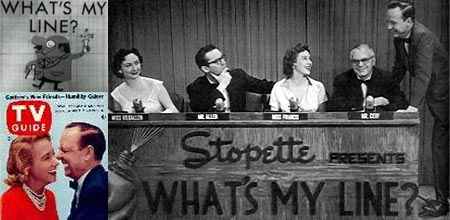
Synopsis of TV Show
“Is it bigger than a breadbox?”
When you’re restricted to yes and no questions, sometimes you have to get a little creative with your queries, which was what What’s My Line? regular panelist Steve Allen was doing with the above. Don’t scoff—plenty of other panelists would enlist the same question in later shows, because somehow, the word “breadbox” always got some laughs. Producers Mark Goodson and Bill Todman were responsible for game shows like I’ve Got a Secret, To Tell the Truth and Match Game, but none were as successful as What’s My Line?. It was the longest-running primetime game show, airing on Sunday nights for a whopping seventeen years.
The driving concept behind the game came along when a colleague of Goodson and Todman’s bet them that he could guess the occupations of complete strangers, using only yes and no questions. That idea spurred a series proposal called “Occupation Unknown,” which later became What’s My Line?
The show assembled a panel of famed or semi-famed personalities, who tried to discover the odd vocations of guests, or the products associated with their jobs. The contestants received five dollars for every ‘no’ answer they doled out, and if they hit ten, they won the game. Each panelist, meanwhile, could continue asking questions until he received a ‘no’ answer, and then it was the next panelist’s turn.
The first contestant was an easy-on-the-eyes blond hatcheck girl from the Stork Club. And the first panelists were a psychiatrist, a poet, a former New Jersey governor, and a newspaper columnist. Obviously, these were no bubbleheads—the show’s panelists were notoriously quick on their feet, and often quite racy. In the final round of each game, the panelists donned blindfolds and chipped away at the identities of celebrity mystery guests, who tried, with varying success, to disguise their voices—Frank Sinatra, Warren Beatty, Walt Disney, Elizabeth Taylor and Alfred Hitchcock were just a few.
John Daly was the host for the seventeen network years, also reading the evening news for ABC during part of that time. In 1967, the show left the network and was resurrected in syndication, with two new hosts. It wasn’t as erudite as before, but there were still a lot of laughs—holdover firecrackers Arlene Francis and Soupy Sales were regulars.
What's My Line? mixed celebrities and everyday folk, smarts with smart acres, and the mix worked, for years and years and years. 'Yes and No' question games were probably never this fun again, and breadboxes were certainly never this funny (or oft-referenced).
Release History of Prime Time Show
2/16/50 - 9/3/67 CBS1968 - 1975 syndicated
TV Sub Categories
game showsTelevision Network
CBS, syndicatedTelevision Studio
Mark Goodson/Bill Todman ProductionsTV Cast
Panelist Arlene FrancisPanelist (1950-65) Dorothy Kilgallen
Panelist (1950-51) Louis Untermeyer
Panelist (1950-53) Hal Block
Panelist (1951-67) Bennett Cerf
Panelist (1953-54) Steve Allen
Panelist (1954-56) Fred Allen