
 TWITTER

S.T.U.N. Runner
Retro Coin Op Synopsis
Atari ushered in the era of 3-D polygon racing with a pair of games in 1989. Hard Drivin’ was the company’s semi-realistic driving simulator, but for a change of pace, S.T.U.N. Runner offered speeds, tricks, weapons and courses that were unlike anything in the 20th century.
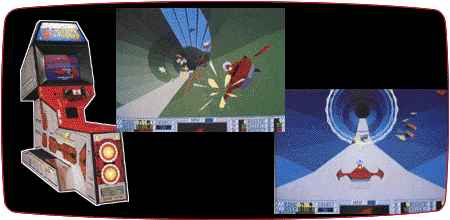
Most of S.T.U.N. Runner’s 20-plus courses took place in an elaborate tube system, racing down the pipes in a time trial. With special “hot spots” to boost you, speeds got up to 900 miles per hour, leaving little room for error. The game accelerated automatically, but it was up to you to guide the ship down the ideal route. Any mistakes cost precious ticks of the clock, endangering your chances of making the next checkpoint for continued play.
Not everyone in the S.T.U.N. Runner world wanted you to succeed, either. Enemy ships roamed the tubes (as did friendly, but annoying trains), and once you reached the outside world, jets tried to drop bombs on your little craft. Taking hits slowed you down considerably, and any kind of impact could break off your wing stabilizers, making control more difficult. To fight back, the S.T.U.N. Runner was equipped with a laser, and you could also collect special “shockwaves,” which wiped out everything in your path.
After completing all courses, including the occasional bonus stage, players were invited to take on the “Ultimate Challenge.” In this unique race, gamers actually got to compete against the records of their predecessors, trying to get farther than anyone who had faced the Ultimate Challenge before. As you passed their end points, players’ names were displayed on the screen, letting you know whose record you had just obliterated.
S.T.U.N. Runner’s on-screen look was matched by its cabinet design, which allowed players to sit as if they were really riding the vehicle itself (the cabinet did not actually move, however). The game was a moderate success in the arcades, but its influence helped shape the look of the 3-D polygon racers that would come to dominate the next decade.
Arcade Machine Release History
1989 - S.T.U.N. RunnerArcade Game Sub Categories
actionracing
simulator