
 TWITTER

Chicago
Synopsis of Pop Music
In the 70’s and 80’s, no prom was complete without one of Chicago's romantic ballads—they're a part of the slow song valhalla that only school dance DJ's have the key to. But dopey high school sweethearts weren't the only ones with an appreciation for the band, because Chicago has racked up over a hundred and twenty million in album sales, and there just can't be a hundred and twenty high school sweethearts out there (and thank God, because the rest of us would never find a place at the drive-ins if there were). With twenty Top-10 singles and twelve Top-10 albums, whether you remember them from the dance floor or not, this was a very big band through the 70's and 80's.
They were was formed, not so surprisingly, in the city of the same name. Four friends from DePaul University recruited other aspiring musicians in 1967, calling themselves The Missing Links and then The Big Thing, playing around town and raising eyebrows with their talk of a fully-integrated horn section. And of course, like many self-respecting rock bands-in-training are wont to do, they rehearsed in the saxophonist’s mother’s basement. An ambitious Chi-Town manager Jim Guercio signed them, and they would soon recruit bass player and vocalist Peter Cetera from a band called The Exceptions.
Guercio persuaded the line-up to change their name to The Chicago Transit Authority, built up their fan base by having them play clubs, especially in Los Angeles, and then sent them off to New York to begin recording their jazz-influenced, self-titled debut double album. In 1970, the group changed their name to just Chicago, thanks to legal threats from the real-life Chicago Department of Transportation, and opened for artists like Janis Joplin and Jimi Hendrix. All along, they moved away from their old jazz-soaked sound, and started to immerse themselves in soft rock and pop.
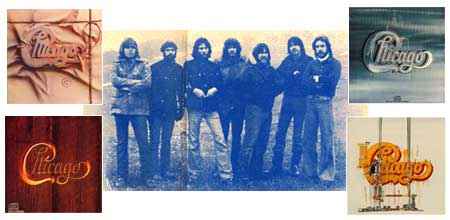
With only a handful of exceptions, each of the band's albums from there on out was titled with a sequential number (they always fought about titles anyway, so this was easier), and the album covers featured a different graphic design takes on the band’s logo (perhaps they fought about artwork too).
They released five albums between 1972 and 1975, all great successes. The string of ballad singles that came from the records included “Color My World,” “Wishin’ You Were Here” (featuring backing vocals from Al Jardine and Carl and Dennis Wilson of the Beach Boys, whom Guercio also managed at the time), and the number one “If You Leave Me Now,” which went gold in 1976. Chicago X was awarded the Best Album Grammy in 1977.
That same year, Guercio and the band parted ways, and tragedy struck in 1978 when founding member and guitarist Terry Kath (whom Hendrix had once declared a better player than himself) accidentally shot himself while he was fooling around with one of the guns in his collection. The band contemplated going their separate ways, but forged on with Donnie Dacus (a former player with Stephen Stills) on guitar, and then Bill Champlin later. Though it had a run of slow years, the group rebounded in 1982 with their successful Chicago 16 and its number one single “Hard to Say I’m Sorry.”
Cetera left to pursue a solo career in 1985, duetting with ladies like Amy Grant, Cher and Abba’s Agnetha Faltskog. He was replaced by Jason Scheff, the son of Jerry Scheff, who was a longtime bass player for Elvis Presley. In 1995, the band acquired the rights to its sixteen Columbia albums and set up its own Chicago Records label to sell their back catalog.
The band, sans Cetera, crooned for Bill and Hilary Clinton at several Presidential events in the early 90’s.
With these kinds of fans and this kind of longevity (in 1998, believe it or not, Chicago 25 was released), the “rehearsal in mom’s basement” should become standard practice for aspiring musicians everywhere.
Artist Release History
1969 – Chicago Transit Authority1970 – Chicago II
1971 – Chicago III
1971 - Liberation
1971 – Chicago at Carnegie Hall (Chicago IV)
1972 – Chicago V
1973 – Chicago VI (Live)
1974 – Chicago VII
1975 – Chicago VIII
1975 – Chicago IX
1976 – Chicago X
1977 – Chicago XI
1978 – Hot Streets
1979 – Chicago XIII
1980 – Chicago XIV
1982 – Chicago XVI
1984 – Chicago XVII
1986 – Chicago XVIII
1988 – Chicago XIX
1989 – Greatest Hits, Volume 3 1982-89
1991 – Group Portrait
1991 – Chicago XXI
1995 – Night and Day
1997 – The Heart of Chicago 1967-1997
1997 – Live in Japan
1998 – The Heart of Chicago, Volume 2 1967-1998
1998 – Chicago XXV
1998 – Chicago Live!
1999 – Rock in Toronto
1999 – In Concert
1999 – Chicago XXVI: Live in Concert
1999 – Chicago
2000 – Live!
2000 – Live ‘69
Pop Sub Categories
popEssential Music Albums
The Heart of Chicago Volume 2, 1967-1998 (Warner Bros)Band Members
Peter Cetera vocals, bassRobert Lamm vocals, keyboards
Terry Kath guitar
Danny Seraphine drums
James Pankow trombone
Lee Loughnane trumpet
Walter Parazaider saxophone
Laudir de Oliveira percussion