
 TWITTER

ER
Synopsis of TV Show
When Michael Crichton was a student at the Harvard Medical School in the late 1960’s, he paid his tuition by writing paperback novels like A Case of Need and The Andromeda Strain. Then in 1974, he wrote a feature film screenplay called EW (for ‘Emergency Ward,’ as emergency rooms were called back then). In the coming years, as he developed a friendship with Steven Spielberg after the director showed him around the Universal lot when The Andromeda Strain was a project at the studio, Crichton described his emergency room concept and Spielberg became interested in directing it as a movie. Interested, that is, until Crichton also mentioned the new dinosaur script he was working on, which Spielberg was very interested in.
Plenty of networks and production companies toyed with producing the script after that, but were wary of its technical language, its torrent of characters with speaking parts, and the way the short, abrupt scenes jumped around and didn’t flow with each other—at least not in the way traditional narrative television typically had scenes flow, which assumed viewers didn't have a capacity for more than a few storylines.
After long years of sporadic interest and no interest at all, executives at Spielberg’s film and TV company dusted it off and held meetings with Crichton and producer John Wells, formerly of China Beach. This time, the take on the ER script was to use its stories as a basis for a dramatic hour-long television show—reality-based, woven with multiple storylines, and shot with a documentary feel and a very fast pace.
The pilot debuted in September of 1994, opposite another medical drama hour-long called Chicago Hope. But from the beginning, the emergency room at Cook County General Hospital was the place more viewers wanted to spend time in—as flies on the wall, mind you, not as patients.
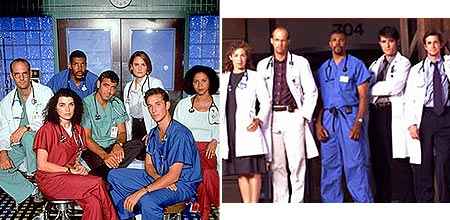
Original casting found Dr. Doug Ross (played George Clooney, who had coincidentally starred in an early 80's sitcom called E/R), a pediatrician who was known for his prowess with the ladies and his frequent rebellion against hospital bureaucracy; chief resident Mark Green, the soon-to-be divorced husband and father whose utter devotion to medicine meant a personal life often mishandled; resident John Carter, young and naïve and constantly dressed down by Dr. Peter Benton, the incredibly skilled doctor who was often devoid of human emotion; Dr. Susan Lewis, compassionate and a good listener to everyone; Nurse Carol Hathaway, who was wheeled in on a gurney during the ER pilot and destined for a very short part indeed, until she became the über-competent ubiquitous chief triage nurse; and Dr. Morgenstern, the acid-tongued head of the emergency room.
After those early days, the cast evolved again and again—though several characters had long tenures, which grounded the show while the doctors and nurses around them paraded in for a season or two and then back out again. The dizzying ‘follow the gurney’ camera work became a show trademark, as did the machine-gun-fast medical patois and the array of blood, vomit and assorted down and dirties of a functioning emergency room—which of course includes the doctors’ and nurses’ personal lives.
This wasn’t the kind of hospital where an employee’s scrubs stay clean and a family life stays smiley, in other words. But that’s exactly why we watched. And watch we did (and do). Starting in the mid-90's, ER put the "must-see" in NBC's "Must-See TV" Thursday night, providing the prime time nightcap to a lineup that has included winners like Seinfeld, Friends and Frasier. It remains a perpetual favorite today, and since the ER itself shows no sign of slowing down, ER likely won't for quite some time either.
Release History of Prime Time Show
9/19/94 - ? NBCTV Sub Categories
dramaTelevision Network
NBCTelevision Studio
NBCTV Cast
Dr. Mark Greene Anthony EdwardsDr. John Truman Carter, III Noah Wyle
Carol Hathaway, RN (1994-2000) Julianna Margulies
Dr. Kerry Weaver (1995-) Laura Innes
Dr. Elizabeth Corday (1997-) Alex Kingston
Lucy Knight (1998-2000) Kellie Martin
Dr. Robert "Rocket" Romano (1997-) Paul McCrane
Dr. Luka Kovac (1999-) Goran Visnjic
Med Student Abby Lockhart (2000-) Maura Tierney
Frank (2000-) Troy Evans
Dr. Cleo Finch (1999-) Michael Michele
Dr. Dave Mallucci (1999-) Erik Palladino
Dr. Jing-Mei "Deb" Chen (1994-95, 2000-) Ming-Na
Jeanie Boulet, PA (1995-99) Gloria Reuben
Dr. Peter Benton Eriq La Salle
Dr. Doug Ross (1994-1999, 2000) George Clooney
Dr. Anna Del Amico (1997-98) Maria Bello
Dr. David Morgenstern (1994-98) William H. Macy
Dr. Angela Hicks (1994-97) CCH Pounder
Dr. Susan Lewis (1994-96) Sherry Stringfield
Dr. Gabriel Lawrence (1999) Alan Alda
Jackie Benton (1995-) Khandi Alexander
Dr. Janet Coburn (1995-) Amy Aquino
Al Boulet (1995-97) Michael Beach
Jerry Markovic (1994-99) Abraham Benrubi
Nurse Conni Oligario Conni Marie Brazelton
Carla Reese (1996-) Lisa Nicole Carson
Nurse Chuny Marquez (1995-) Laura Ceron
Kynesha Toy Connor
Nurse Lydia Wright Ellen Crawford
David Greene (1997-2000) John Cullum
Nurse Malik McGrath Deezer D
Elaine Nichols (1999) Rebecca De Mornay
Charlene "Charlie" Chiemienga (1996-97) Kirsten Dunst
Paramedic Ray "Shep" Shepard (1995-96) Ron Eldard
Harper Tracy (1995-96) Christine Elise
Dr. Dennis Gant Omar Epps
Dr. Maggie Doyle (1996-99) Jorja Fox
Nurse Haleh Adams Yvette Freeman
Officer Al Grabarsky Mike Genovese
Cynthia Hooper (1997-98) Mariska Hargitay
Jennifer Greene (1994-) Christine Harnos
EMT Pamela Olbes (1995-) Lynn A. Henderson
Nurse Practitioner Lynette Evans (1998-99) Penny Johnson
Nurse Shirley (1995-) Dinah Lenney
Nurse Kit (1996-) Bellina Logan
Nurse Wendy Goldman (1994-98) Vanessa Marquez
Nurse Lily Jarvik Lily Mariye
Randi Fronczak (1995-) Kristin Minter
E. Ray Bozeman (1995-97) Charles Noland
Linda Farrell (1994-95) Andrea Parker
Frankenstein Wilson Raiser
Dr. John Taglieri (1994-95) Rick Rossovich
EMT Zadro (1995-) Monte Russell
Chase Carter (1997-98) Jonathan Scarfe
EMT Doris Pickman Emily Wagner
Nurse Yosh Takata (1997-) Gedde Watanabe
Chloe Lewis (1994-96) Kathleen Wilhoite
Officer Reggie Moore (1998-99) Cress Williams
Diane Leeds (1995-) Lisa Zane
Rachel Greene Yvonne Zima