
 TWITTER

The Hollies
Synopsis of Pop Music
“Bus stop, wet day,
She’s there, I say,
Please share my umbrella...”
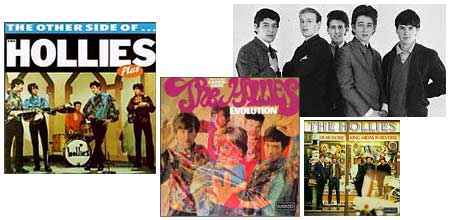
The Hollies were probably the most purely ‘pop’ of all the British Invasion bands. While groups like the Beatles would sometimes toy with non-pop experiments, the Hollies kept their material catchy and appealing no matter what style they pursued. Building on a distinctive three-part harmony vocal style, the group wrote much of their own material and earned over a decade’s worth of hits in the process.
The Hollies began in 1961 when Graham Nash and Allan Clarke expanded their vocal duo, the Two Teens, to become a full band. Dubbing themselves the Hollies in honor of Buddy Holly, the group got a record contract in 1963 and had their first English hits with covers of r&b classics like “Stay” and “Searchin.” They had their first American Top-40 single with the airy harmonies of “Look Through Any Window” and their first American smash with the catchy “Bus Stop.”
The Hollies had further big hits throughout 1966 and 1967 with “Stop Stop Stop,” “On A Carousel” and “Carrie Ann,” all of which wrapped addictive melodic hooks in the group’s unique three-part harmonies. “Stop Stop Stop” is also interesting because it is credited to one ‘L. Ransford,’ a pseudonym used by the songwriting team of Clarke, Nash and guitarist Tony Hicks. The Hollies began to experiment as the 60’s progressed, resulting in psychedelic-styled albums like Butterfly and the memorable, orchestra-backed single “King Midas In Reverse.”
Graham Nash left the Hollies in 1968 and soon joined the American supergroup Crosby Stills and Nash. The Hollies moved forward, doing an album of Bob Dylan songs called Hollies Sing Dylan in 1969 and having an international hit with the serious ballad “He Ain’t Heavy, He’s My Brother.” Budding superstar Elton John played piano on this hit. The band would have another major hit in 1972 with “Long Cool Woman In A Black Dress,” a roots-rocker penned and sung by Clarke that was reminiscent of Creedence Clearwater Revival. It represented the grittier, stripped-down direction they were moving in at the time
Clarke had left the group by this time to pursue a solo career. He would return in 1973 and the Hollies would have another international hit with “The Air That I Breathe.” This song returned the group to their orchestral style in grand fashion. The group continued to record and tour throughout the 70’s. Graham Nash decided to reunite with the Hollies in the early 80’s and they found worldwide success with an update of the Supremes classic “Stop! In The Name Of Love.”
The Hollies continue to tour and record today, but their status as pop music legends is already assured. Their classics are frequently reissued and win the band new fans all the time thanks to the durability and imagination of the group’s songwriting. The group was also the subject of a tribute album, Sing Hollies In Reverse, in 1995. It featured major alternative-rock figures like the Posies and Material Issue covering their Hollies favorites, thus proving the enduring nature of the group’s work. And it’s a sure bet that the Hollies’ music will continue to delight lovers of pop for pop's sake for a long time.
Artist Release History
1964 - Here I Go Again1964 - In the Hollies Style
1964 - Stay with the Hollies
1965 - Hear! Here!
1965 - The Hollies
1966 - Beat Group!
1966 - Would You Believe?
1966 - Bus Stop
1966 - The Hollies
1966 - Stop! Stop! Stop!
1966 - For Certain Because
1967 - Butterfly
1967 - Evolution
1968 - King Midas
1969 - Hollies Sing Hollies
1969 - He Ain't Heavy, He's My Brother
1969 - Words and Music by Bob Dylan
1970 - Confessions of the Mind
1970 - Moving Finger
1971 - Distant Light
1972 - Romany
1973 - Out On the Road
1974 - The Hollies
1975 - Another Night
1976 - Russian Roulette
1977 - Clarke, Hicks, Sylvester, Calvert and Elliot
1977 - Everything You Always Wanted to Hear
1978 - A Crazy Steal
1978 - The Other Side of the Hollies
1979 - Five Three One - Double Seven O Four
1980 - The Air That I Breathe
1982 - Pay You Back with Interest
1982 - Live
1983 - What Goes Around
2000 - Orchestral Heaven
Pop Sub Categories
popEssential Music Albums
All-Time Greatest Hits (Curb)Epic Anthology (Epic)
Band Members
Allan Clarke (1961-71, 1973-2000) lead vocalsGraham Nash (1961-68, 1983) vocals, guitar
Tony Hicks guitar
Eric Haydock (1961-66) bass
Don Rathbone (1961-63) drums
Bobby Elliott (1963- ) drums
Bernie Calvert (1966-81) bass
Terry Sylvester (1969-81) vocals, guitar
Mikael Rickfors (1971-73) lead vocals
Denis Haines (1984- ) keyboards
Alan Coates (1984- ) vocals
Ray Stiles (1984- ) bass
Carl Wayne lead vocals (2000- )