
 TWITTER

When Worlds Collide
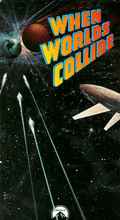
Synopsis of Movie
Before there was Deep Impact and Armageddon, world destruction was done up in 1950’s sci-fi style.
The rights to Philip Wylie and Edwin Balmer's 1932 doomsday novel When Worlds Collide belonged to Cecil B. DeMille for a time and languished on the shelves. In 1950, producer George Pal got his hands on the project, and eager for a follow-up to Destination Moon, Pal made sure it languished no more.
South American pilot David Randall flies to the States, armed with classified astronomical information that he is supposed to deliver to Dr. Hendron. Lucky for him, Hendron’s sexy daughter Joyce brings him right to Daddy. The super-secret documents, unfortunately, predict what Hendron has feared for quite some time…the end of the world is a-coming, thanks to a giant asteroid that’s on a collision course to Earth.
When the good doctor presents his hypothesis to a UN committee, he is roundly mocked. The only believers are from the private sector, led by wheelchair-bound millionaire Sydney Stanton. Stanton forks over enough money to fund Hendron’s survival plan: a huge space ark that will transport a small group of people to an inhabitable moon called Zyra.
Construction ensues. The giant spaceship is hammered out by a group of 600 young men and women, who toil away in hopes of being one of the Hendron’s lucky lottery winners—the prize being a seat on the ship when it finally takes off.
Alas, the asteroid does hit our fair planet, and we see various glimpses of world destruction (which helped win the film the Academy Award for Special Effects), including the flooding of New York City. Hendron’s ship, packed up with the world’s great literature and forty lucky travelers, careens down a huge ski jump-type ramp and takes off in the nick of time. Takes off, however, sans a few familiar faces. Do lovebirds Joyce and David make the cut? Or are they, in that most awful Titanic couple-separation tradition, to be tragically torn apart?
In the throes of 1950’s Cold War paranoia, the notion of the end of the world wasn’t just a notion. It was a honest-to-goodness, keep-you-up-at-night fear. Take the Cold War and mix it with Pal’s usual fire-and-brimstone, "The Second Coming Is Near" type of religious themes, and you have more than enough psychological context for this movie’s apocalyptic premise to really resonate.
Pal tried to no avail to get a sequel off the ground (silly pun intended), which would have been based on the novel’s sequel, After Worlds Collide.
Movie Release History
1951 - When Worlds CollideMovie Sub Categories
live-actionsci-fi/fantasy
action/adventure
Movie Studio
ParamountCast
David Randall Richard DerrJoyce Hendron Barbara Rush
Dr. Tony Drake Peter Hanson
Sydney Stanton John Hoyt
Dr. Cole Hendron Larry Keating
Julie Cummings Judith Ames
Dean George Frye Alden 'Stephen' Chase
Harold Ferris Frank Cady
Dr. Emery Bronson Hayden Rorke
Dr. Ottinger Sandro Giglio
Student Mary Murphy
Rioter Bringing Guns Kirk Alyn
Traveler Gertrude Astor
Newsdealer Gene Collins
Eddie Garson James Congdon
Headwaiter Marcel De la Brosse
Traveler Estelle Etterre
Complaining Man at Airport Sam Finn
Narrator (voice) Paul Frees
Paul Art Gilmore
Frenchman Ramsay Hill
Indian Chairman Hassan Khayam
Mike Rudy Lee
Rudolph Marsden Freeman Lusk
Clerk William Meader
Glen Spiro Joseph Mell
Leda Gay Nelson
Stanley Keith Richards
Chief Inspector John Ridgely
Stewardess Kasey Rogers
Alice, Hendron's receptionist Frances Sandford
Donovan (reporter) James Seay
Matron with Cigarette Queenie Smith
Dr. Zenta Harry Stanton
Extra (by bunk during riot instigation) Stuart Whitman