
 TWITTER

Neil Diamond
Synopsis of Pop Music
"Hands, touching hands,
Reachin' out, touching me, touching you..."
To call Neil Diamond a successful pop musician would be an understatement. In a little over thirty years, he has scored over 60 hits and sold enough records to make himself one of the twenty biggest-selling pop artists of all time. Diamond has achieved this immense fame by combining his knack for crafting timeless pop melodies with an ability to grow with the times. In the process, he has developed a style of pop music whose appeal cuts across many different ages and tastes.
Neil Diamond’s musical career began when he received a guitar as a birthday gift at age 16. He began recording as a teenager and devoted all his spare time to writing songs. He left college to become a songwriter in 1965 and also continued to record his own music. This double workload paid off when the Monkees hit the Top-10 with Diamond’s song “I’m A Believer” and he scored his own Top-10 hit with the exuberant pop-rocker “Cherry Cherry.” He also got plenty of radio play with “Solitary Man,” a moody midtempo song that continues to be a favorite on oldies stations today.
Songs like “Girl You’ll Be A Woman Soon” and “Red Red Wine” kept the hits rolling for Neil Diamond well into 1968. These two songs were covered years later by other performers, Urge Overkill and UB40 respectively, with great success. Around this time, Diamond began exploring a more introspective, autobiographical style in his songs a la Bob Dylan. He also began adding gospel and country elements to his sound. The new direction paid off when he scored two million-selling hits in 1969 with “Sweet Caroline” and “Holly Holy,” two dramatic and exquisitely-crafted pop tunes.
As the 1970’s began, Neil Diamond continued to expand the form of the pop song. His album Tap Root Manuscript explored world-beat rhythms in “An African Trilogy” and the harmony-rich “Soolaimon.” It also contained Diamond’s first #1 hit, the gentle, romantic “Cracklin’ Rosie.” In 1971, he went Top-5 with the autobiographical “I Am I Said,” a tough-to-write song Diamond later confessed took four months to finish. He hit #1 in 1972 with “Song Sung Blue,” a song with sweet harmonies and a distinctive bell-sound hook. He also hit big with Hot August Night, a double-live album of a memorable Los Angeles concert.
In 1973, Neil Diamond did his first soundtrack for the nature-themed film Jonathon Livingston Seagull. He went Top-10 in 1974 with “Longfellow Serenade.” He appeared as part of the Band’s final concert in 1976, and footage of this appeared in the film The Last Waltz. In 1978, Diamond had one of his biggest hits with “You Don’t Bring Me Flowers,” a romantic duet with Barbara Streisand. Interestingly, this song was originally recorded separately by both artists. When a disc jockey got attention by splicing the two versions together, Diamond and Streisand recorded a proper duet version that earned them a hit.
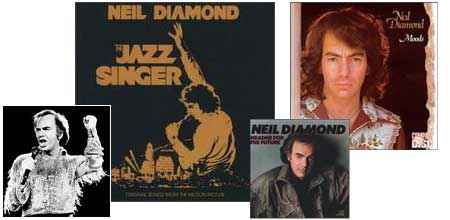
Neil Diamond took on the motion picture world in 1980 by starring in a modern update of the first talkie, The Jazz Singer. He also did the film’s score, which included three big hits in the patriotic “America,” the romantic “Hello Again” and the break-up lament “Love On The Rocks.” He continued to sell albums throughout the 1980’s with efforts like Heartlight and Headed For the Future. He continued to tour during this era and did the occasional special performance like his rendition of ‘The National Anthem’ at the 1987 Super Bowl.
In the 1990’s, Diamond continued to perform and record prolifically. He often did theme albums like Up On The Roof – The Songs Of The Brill Building and Tennessee Moon, an album of country sounds. Most recently, he has recorded The Movie Album, an album of film themes that covers everything from Casablanca to Titanic. He also remains a major draw at concert halls around the world, proving that his timeless take on pop music still has plenty of fans.
Artist Release History
1966 - The Feel of Neil Diamond1967 - Just for You
1968 - Velvet Gloves & Spit
1969 - Brother Love's Traveling Salvation Show
1969 - Sweet Caroline: Brother Love's Traveling...
1969 - Touching You, Touching Me
1970 - Shilo
1970 - Tap Root Manuscript
1971 - Do It!
1971 - Stones
1972 - Moods
1972 - Hot August Night (live)
1973 - Jonathan Livingston Seagull
1973 - Rainbow
1974 - Serenade
1975 - Focus on Neil Diamond
1976 - And the Singer Sings His Song
1976 - Beautiful Noise
1977 - Love at the Greek (live)
1977 - I'm Glad You're Here with Me Tonight
1978 - Carmelita's Eyes
1978 - You Don't Bring Me Flowers
1979 - September Morn
1979? - Voices of Vista: Show #200
1980 - The Jazz Singer
1981 - Diamonds
1981 - Love Songs
1981 - On the Way to the Sky
1982 - Live Diamond
1982 - Heartlight
1983 - Classics: The Early Years (compilation)
1984 - Primitive
1986 - Headed for the Future
1987 - Hot August Night 2 (live)
1988 - The Best Years of Our Lives
1991 - Lovescape
1992 - The Christmas Album
1993 - Up on the Roof: Songs from the Brill Building
1994 - The Christmas Album, Vol. 2
1995 - Live in America
1996 - Tennessee Moon
1996 - I Knew Love
1997 - Live in Concert
1998 - The Movie Album: As Time Goes By
1999 - The Neil Diamond Collection
Pop Sub Categories
popEssential Music Albums
Classics: The Early Years (Sony)Neil Diamond Collection (MCA)
Twelve Greatest Hits, Volume 2 (Sony)